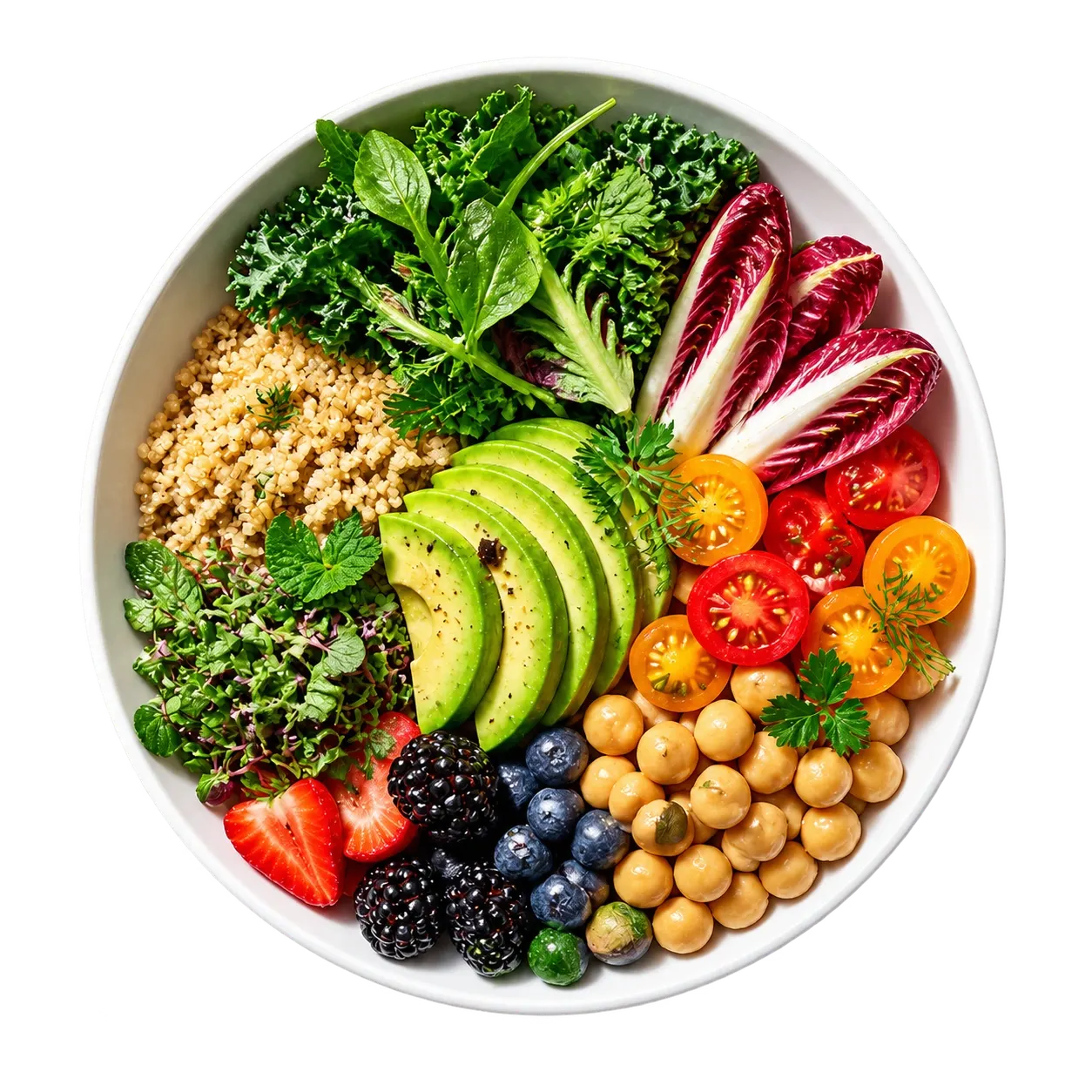


A gut score from 0 to 100
Every meal starts at 40. Fiber, plant variety and gut fuel like legumes, whole grains and ferments raise it. Ultra-processed, fried and very sugary food lowers it. The rules are public.
Feel better from the inside out.
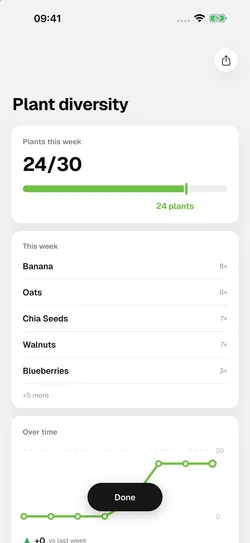
Snap any meal. Feed Your Gut shows the fiber in grams, counts your plants toward 30 a week and scores the meal for your gut, with one clear thing to try next.
Grounded in published research
Your gut microbiome eats what you eat. Gut health comes down to two things the research backs most: fiber, about 30 grams a day, and plant variety, 30 different plants a week. Feed Your Gut makes both visible from a single photo, so better choices stop being guesswork.
30+1
different plants a week
went with a more diverse gut microbiome than 10 or fewer, across more than 10,000 people in the American Gut Project.
25–29g2
of fiber a day
was where the lowest risk of heart disease, stroke, type 2 diabetes and colorectal cancer showed up, across 185 cohort studies and 58 trials.
95%3
of Americans
fall short of the recommended fiber intake. Most adults eat around 15 to 16 grams a day.
194
inflammation markers
went down in a Stanford trial when healthy adults ate more fermented foods for ten weeks. Microbiome diversity went up.
No weighing, no searching a database, no counting. Point the camera at your plate and Feed Your Gut does the rest.
Take a photo, scan a barcode or type a line like “sugar free granola with kefir”. What you type stays exactly as you wrote it.
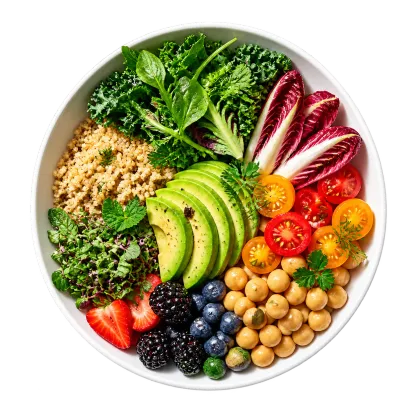
Fiber in grams, every plant identified, ferments told apart and a gut score from 0 to 100, explained in plain language.
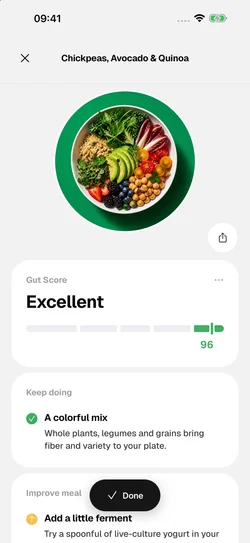
One specific suggestion for next time, and a week view that shows your plants climbing toward 30 and your fiber toward 30 g.
Built around the signals the research actually supports. Nothing you have to weigh, nothing that moralizes your food.
Every meal starts at 40. Fiber, plant variety and gut fuel like legumes, whole grains and ferments raise it. Ultra-processed, fried and very sugary food lowers it. The rules are public.
Real grams per meal and across the day, measured against the 30 g most European guidelines recommend. Not low, medium or high.
Every different plant counts once per week, herbs, spices, seeds and grains included. The count fills itself as you scan.
Live cultures in kefir, yogurt or fresh kimchi count as probiotic. Pasteurized sauerkraut or baked sourdough count as fermented, not live.
A separate scale from −5 to +5 for omega-3, olive oil, polyphenols and spices on one side, processed meat, deep frying and sugar load on the other.
How your gut feels, bloating, energy and stress. Over the weeks you see what your food has to do with it, plus streaks and weekly challenges to keep going.
No black box. Every meal starts at 40 and moves for reasons you can see. Two meals, the same rules:
Read the full scoring rulesIllustrative examples. The analysis applies the same rules with judgment, so a real scan can land a few points either way. Your daily score adds up the whole day, and one heavy meal never erases a good morning.
Calorie apps were built for the scale. Feed Your Gut is built for the trillions of microbes that live on the part of your food you cannot digest yourself.
| Feed Your Gut | Typical calorie counter | |
|---|---|---|
| Fiber in grams, per meal and per day | Yes | Sometimes |
| Counts your plant diversity across the week | Yes | No |
| Tells live ferments from pasteurized ones | Yes | No |
| Scores every meal for gut health | Yes | No |
| Logs a meal from one photo | Yes | Sometimes |
| Keeps calories in the background | Yes | No |
| Works without an account | Yes | Sometimes |
Sometimes. Protein and calories still ride along in Feed Your Gut as neutral estimates. They never change the gut score.
Open the app and scan. There is no profile to create and nothing to log into.
Your meals and check-ins live on your iPhone and in your own iCloud.
A meal photo goes to our server for the analysis and is deleted right after.
Feed Your Gut is not a medical device. If symptoms stay with you, talk to a clinician.
Something missing? Write to us
Gut health means a diverse, well-fed community of gut microbes. The best-supported ways to improve it are about 30 grams of fiber a day, 30 different plants a week and fermented foods with live cultures, like kefir or yogurt. Feed Your Gut tracks all three from a photo of your meal. This is general information, not medical advice.
Feed Your Gut is a gut health app for iPhone. You snap a photo of a meal, scan a barcode or type what you ate. The app shows the fiber in grams, counts every different plant toward a goal of 30 a week and scores the meal from 0 to 100 for gut health, with one specific suggestion for next time.
Every meal starts at 40. Fiber adds 4 points per gram, up to 30. Gut fuel adds up to 30 more: live probiotic foods +14, other fermented foods +8, legumes +10, whole grains +8, and nuts, seeds, polyphenols and prebiotics +5 each. Each whole plant adds 3, up to 12. Ultra-processed food and processed meat subtract up to 25, deep-fried food 20, added sugar 15 and refined grains 10, weighted by how much of the meal they make up. The result is clamped between 0 and 100.
In the American Gut Project, published in mSystems in 2018, people who ate more than 30 different plant types a week had more diverse gut microbiomes than people who ate 10 or fewer. Diversity mattered more than the diet label, vegan or omnivore. Vegetables, fruit, legumes, whole grains, nuts, seeds, herbs and spices all count, and each plant counts once per week.
Most adults should aim for about 30 grams a day. That is the recommendation of the German Nutrition Society (DGE) and the UK’s SACN. US guidelines give 14 grams per 1,000 calories, which works out to roughly 25 grams for women and 38 grams for men. A 2019 Lancet meta-analysis found the lowest disease risk at 25 to 29 grams a day or more.
No. The headline numbers are fiber, plant diversity and the gut score. Protein and calories are shown as neutral estimates for people who want them, and they never change the gut score.
No. There is no sign up. Your history stays on your iPhone and in your own iCloud.
A photo goes to our server for the analysis and is deleted right after. Your meal history itself lives on your iPhone and in your own iCloud. The privacy policy has the full details.
Feed Your Gut is a subscription app, so scanning needs an active plan. You can choose a yearly, monthly or weekly plan, and the yearly plan starts with 3 days free. Prices are shown in the app before you confirm, and you can cancel anytime in your Apple account settings.
Not yet. Feed Your Gut is currently available for iPhone, in English, German and Spanish.
No. Feed Your Gut is not a medical device and does not diagnose or treat any condition. If you have ongoing digestive symptoms, a diagnosed condition such as IBS or IBD, or a special diet, talk to a doctor or registered dietitian.
Find out where you actually stand. It takes one photo.
Download on the App StoreFor iPhone. Yearly plan starts with 3 days free.
 Oats
Oats  Kiwi
Kiwi  Chickpeas
  Kale
Kale  Walnuts
  Tomato
  Blueberries
  Avocado
  Carrot
  Broccoli
  Kimchi
 21
21